On this September 4, 2025 broadcast, Kim Monson examines Colorado’s mounting tax challenges with insights from policy experts Ramey Johnson and Bob Boswell, explores property rights issues with Karen Gordey and Karen Levine, and concludes with a riveting historical account from Colonel Bill Rutledge about the deadliest natural disaster in American history.
Karen Gordey, owner of Radiant Painting and Lighting and candidate for Lakewood City Council, secured a rare victory at a recent city council meeting. After speaking for 10 minutes about property rights and government overreach, the council amended its citywide rezoning proposal to address rebuilding rights after disasters. Gordey warns that Lakewood’s rezoning plan threatens homeowners by allowing commercial retail in residential neighborhoods while restricting business hours, a move she sees as government overreach.
The discussion highlights tensions between municipal development goals and individual property rights, with Gordey questioning why cities maintain rigid zoning rules for small businesses like Effolaw French Bakery while simultaneously overhauling regulations on a massive scale.
“As you know, Lakewood is rezoning the entire city. And last Monday I was able to pull time, so I had 10 minutes to speak, and really hit them on property rights and government overreach And as a result, after public comment was done, you know, two and a half hours later, when they were making amendments, they actually did make an amendment regarding the rebuilding of a home after a disaster.”
Karen Gordey, Lakewood City Council Candidate
Ramey Johnson, former state legislator and Colorado Union of Taxpayers board member, draws on observations from a recent European trip to contrast homelessness approaches worldwide. She points to Greenwood Village as a model, where officials “kill the homeless with kindness” through conduct-based enforcement that treats all residents equally regardless of housing status.
Johnson connects homelessness policy to broader political strategy, noting that Governor Polis fast-tracked legislation designating areas near light rail as high-density transit-oriented development. She argues this creates incentives for cities to tolerate visible homelessness, which depresses property values and opens the door for developers to build high-density housing that could shift the political landscape.
“He said they treat their homeless like soccer moms.”
Ramey Johnson, Colorado Union of Taxpayers
Bob Boswell, CEO of Laramie Energy, exposes how state-backed school construction projects burden rural Colorado communities. In Collbran, Mesa County, a farming community of 2,500 people, voters approved a $70 million school improvement bond for just 240 students, working out to $291,000 per student before hiring a single teacher.
Boswell explains that his company pays 70 percent of the county’s taxes, and regulations targeting energy development simultaneously hurt economic growth while increasing tax burdens on farmers and ranchers. He connects this to Colorado’s broader fiscal crisis, noting the state has moved from surplus to an estimated $800 million to $1.2 billion deficit, with officials using fees to circumvent TABOR’s requirement for voter approval of tax increases.
“It’s important that the taxpayers, the communities of the state of Colorado, understand that there’s no such thing as a free lunch, and promises are made for political gain that need to be underwritten and financed.”
Bob Boswell, CEO of Laramie Energy
Karen Levine, RE/MAX realtor and property rights advocate, analyzes Denver’s “Vibrant Denver” ballot measure, which extends debt rather than raising taxes outright. She notes that while Denver ranks as the ninth most dangerous city in America according to The Hill, officials seek more money rather than addressing public safety and quality-of-life concerns that have transformed the city.
Despite political headwinds, Levine reports the metro real estate market remains strong. She closed a sale over Labor Day weekend in a community where no new listings had appeared all summer, demonstrating that demand persists in desirable areas even as some residents flee the state’s rising costs.
“Over Labor Day weekend, I listed a property and I sold the property.”
Karen Levine, RE/MAX Realtor
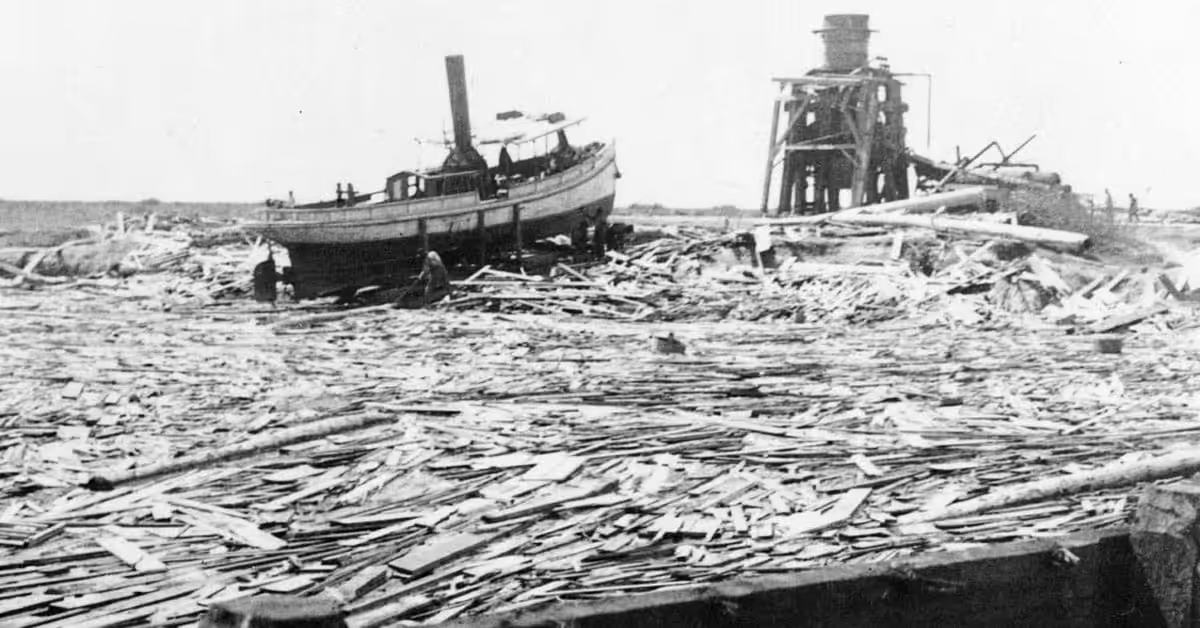
Colonel Bill Rutledge, 97-year-old retired Air Force officer, recounts the deadliest natural disaster in American history: the September 8, 1900 hurricane that killed between 8,000 and 12,000 people in Galveston, Texas. The storm struck with almost no warning because officials in Washington had severed communication with Cuban meteorologists who correctly predicted the hurricane’s path due to professional jealousy.
Rutledge emphasizes that Galveston’s tragedy occurred before automobiles became common, challenging climate alarmist narratives that attribute modern storms to human activity. The island sat only six feet above sea level with no breakwater protection, and the Category 5 storm brought 200-mile-per-hour winds and a 15-foot tidal surge that swept away thousands, including nearly every child and nun at a beachfront Catholic orphanage.
The disaster prompted construction of a massive seawall and led to improved weather forecasting coordination. Rutledge notes that Colonel Henry Robert, who oversaw the engineering response, later became famous for writing Robert’s Rules of Order.
“Every time I think of a whole world and the economy being dictated by a teenager from Sweden, it blows my mind. It’s so irrational.”
Colonel Bill Rutledge, Retired USAF

Jason McBride with Presidential Wealth Management joins Kim to review the stock market’s reaction to viruses and media mentions in the past 20 years,...
Episode from The Kim Monson Show
2022 Colorado gubernatorial candidate Greg Lopez is in-studio with Kim to dissect what happened in Tuesday’s election nationwide, ramifications for Colorado in the future,...