On this Independence Week broadcast, Kim Monson explores two foundational ideas that shaped America: the vital role of carbon dioxide in sustaining life on Earth and the revolutionary concept in the Declaration of Independence that rights come directly from God to individuals, not through intermediaries. Patrick Moore, the environmental scientist who co-founded Greenpeace, and Jay Davidson, founder of First American State Bank, offer their perspectives.
Patrick Moore, author of Fake Invisible Catastrophes and Threats of Doom, challenges the prevailing narrative that carbon dioxide threatens human survival. The environmental scientist and former Greenpeace co-founder argues that CO2 represents the very foundation of all carbon-based life on Earth. Without carbon dioxide in the atmosphere and oceans, no plants could exist, and without plants, no animals could survive.
Moore traces the origin of fossil fuels to ancient living organisms that died and became trapped in sediments, removing their carbon from the natural cycle. He contends that by burning these fuels, humanity performs a vital service by returning carbon to the atmosphere where plants can use it. At current levels of approximately 425 parts per million, CO2 remains far below historical highs of 5,000 ppm when trees first evolved. Moore advocates for nuclear energy as a balanced approach to maintaining atmospheric carbon levels while reducing dependence on fossil fuels.
“Humans are the salvation of life on Earth because we are the only species that can take the coal, oil, and gas that has been locked away in sediments where it can’t get back into the life cycle. We’re putting it back into the life cycle.”
Patrick Moore, Environmental Scientist and Greenpeace Co-founder
Jay Davidson examines what made the American founding truly revolutionary in human history. For millennia, the prevailing worldview held that ordinary people needed an intermediary to connect with the divine, whether a pope, pharaoh, monarch, or religious figure. Thomas Jefferson shattered this paradigm in the Declaration of Independence by asserting that the divine spark of the Creator exists within each individual.
This concept carries profound implications: if individuals possess direct connection to their Creator, then certain rights become truly inalienable. No person, government, or institution can legitimately take away what God bestowed directly. Davidson notes that the original draft referred to “life, liberty, and property” as inalienable rights, changed to “pursuit of happiness” to gain support from slave-holding states. This compromise, while necessary to form the nation, planted seeds of conflict that erupted in the Civil War.
Davidson emphasizes that the Constitution was designed specifically to limit government power, not individual rights. The document applies almost exclusively to government action, establishing a framework where the people govern themselves under the rule of law in a constitutional republic.
“And if that is the case, and it is, then there are certain inalienable rights, and he’s used the word inalienable appropriately, because these rights are bestowed on us by our creator.”
Jay Davidson, Founder and CEO of First American State Bank
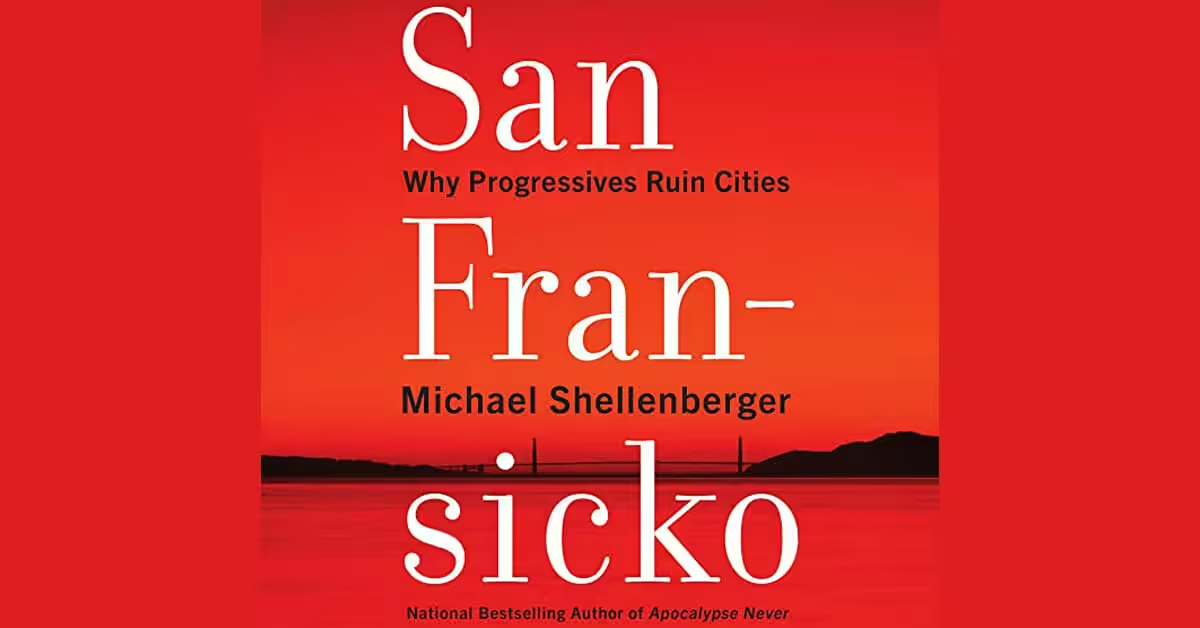
On Friday, September 23, 2022, Kim Monson explored the failures of progressive urban policies and celebrated American military heritage with featured author Rick Turnquist...

On this Thursday broadcast from Virginia, Kim Monson examines the intersection of financial freedom and bodily autonomy with two expert guests. From Monticello, Jefferson’s...
Today is Kim’s Ancestry Show. “We the People” must learn and love our history in order for our Constitutional Republic to remain strong. The...