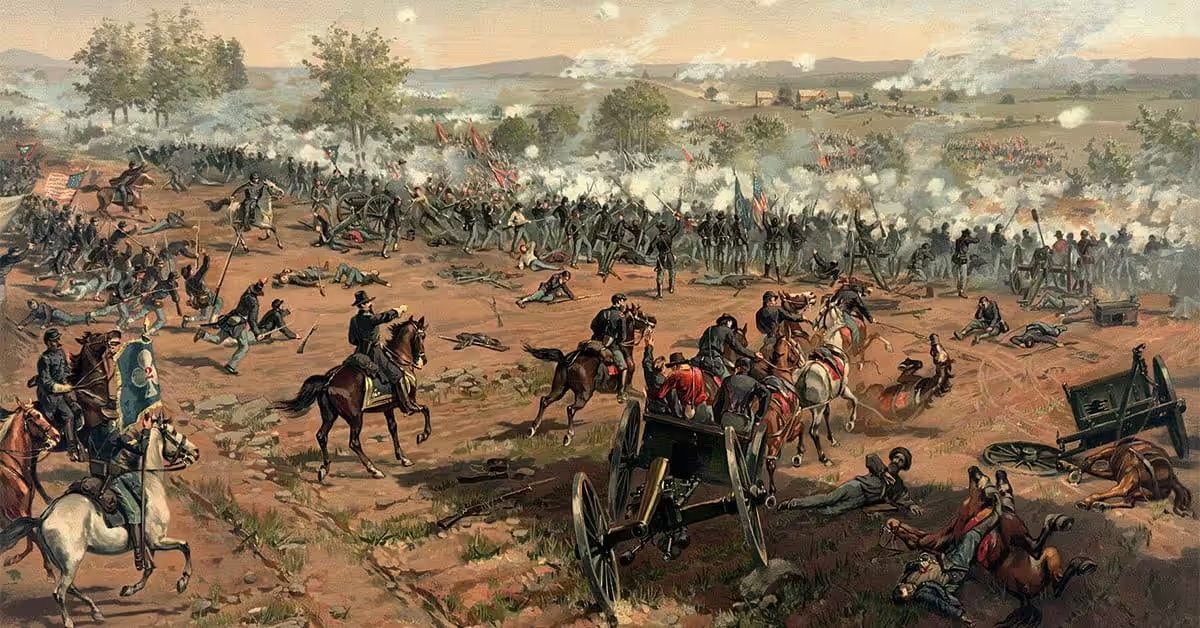
On July 1, 2025, Kim Monson welcomes Judge Phil Ginn of the Southern Evangelical Seminary to explore why the founders placed religious freedom first in the Bill of Rights, followed by historian Dr. Allen Guelzo discussing the Civil War’s pivotal battle that preserved the Union, and Brad Miller examining how modern manipulation techniques threaten free thought.
Phil Ginn, president of the Southern Evangelical Seminary and former North Carolina Superior Court judge, argues that religious freedom holds the premier position in the First Amendment for good reason. The founders, he explains, understood that Massachusetts operated as a theocracy during the Revolutionary era, with Rhode Island forming specifically because of religious persecution within Christianity itself. Ginn notes that his state, North Carolina, refused to ratify the Constitution until the Bill of Rights guaranteed freedom to worship and serve God according to individual conscience.
The seminary president sees evidence of spiritual awakening across American college campuses. At Auburn, Florida State, Ohio State, Clemson, and Appalachian State universities, students are seeking answers that secular culture cannot provide. George Barna’s research indicates Gen Z males represent the demographic most actively pursuing faith, presenting what Ginn calls an opportunity to raise a generation of Bible-believing men. The church’s role, he insists, extends beyond stained glass windows into the public marketplace of ideas.
“My dad used to, who’s a Baptist preacher, told me on many occasions he’d never seen anybody bludgeoned into the kingdom of heaven.”
Phil Ginn, President, Southern Evangelical Seminary
Allen Guelzo, senior research scholar at Princeton’s James Madison Program and author of the New York Times bestseller on Gettysburg, reveals how close Robert E. Lee came to winning his gamble in Pennsylvania. Lee understood the Confederacy lacked the industrial capacity for a prolonged war. His invasion aimed to demoralize Northern voters before the 1863 gubernatorial elections in Pennsylvania and Ohio, potentially forcing Lincoln into negotiations.
The historian traces slavery’s role as the war’s fundamental cause. While sectionalism and federalism contributed, removing slavery from the equation eliminates any path to civil war. Southern states declared their intentions plainly in 1861 secession documents, though postwar revisionism attempted to obscure this truth. Guelzo draws parallels between the dehumanization required to justify slavery and the patterns preceding every genocide in history.
“More even than weapons of war, bombs, economic strategies, it was Solzhenitsyn’s book that spelled the end of the Soviet Union.”
Allen Guelzo, Senior Research Scholar, Princeton University
Guelzo emphasizes that Abraham Lincoln, despite barely a year of formal schooling, developed voracious reading habits that shaped his presidency. His law partner William Henry Herndon documented Lincoln’s office library, filled with works on political economy, philosophy, and annual scientific publications. Lincoln possessed near-photographic memory, able to recite lengthy passages of Shakespeare and 18th century poetry. When challenged about his knowledge of geometry, Lincoln simply obtained the book and mastered it.
The professor argues that books remain fundamentally subversive. Tyrants prioritize controlling what people read because reading opens alternative universes and possibilities that screens cannot match. Lincoln himself drew a direct line from a biography of Washington he read as a boy in Kentucky to the principles he defended as president during his 1861 address to the New Jersey Senate in Trenton.
“A book, a book explodes the mind. A book gives you access to realities that you can’t touch. It gives you alternative universes you can inhabit. A book will move you to do things that a screen can never even come close to doing.”
Allen Guelzo, Senior Research Scholar, Princeton University
Brad Miller, former Army Colonel and instructor for the IPAC Literature as Resistance course, explains how the Hegelian dialectic and Delphi technique can be weaponized to constrain public opinion. Originally developed as legitimate corporate decision-making tools, these methods become problematic when powerful networks use them to guide citizens toward predetermined conclusions while maintaining the illusion of participation.
Miller recounts how COVID-era policies followed the classic problem-reaction-solution model, urging listeners who awakened during that period to remain vigilant. The government capable of implementing such measures will continue attempting similar manipulation. Understanding these tools and techniques represents the first step toward intellectual self-defense.
“Whenever you feel like legitimate debate is not being held, you have to ask yourself if you believe that your opinions are being manipulated or if you believe that your thoughts are being shaped in a previously contrived direction.”
Brad Miller, Former Army Colonel, IPAC Instructor

Episode from The Kim Monson Show
r. James Lyons-Weiler and Dr. Jill Vecchio discuss the hypocrisy of Washington's elite April 6th superspreader event at the annual DC Gridiron dinner. They...

On September 21, 2022, Kim Monson welcomed Constitution Week organizers Mike Tompkins and Marc Auville to celebrate the 11th annual Grand Lake U.S. Constitution...